Who Paid for the Outrage? Following the Money Behind Capone and Tobacco’s Attacks
Campaign finance records show payments to a political consulting firm linked to a local news outlet that published and amplified favorable coverage during an active school board race, raising new questions about transparency in Middletown’s political messaging ecosystem.
Local political influence doesn’t always arrive through ads or mailers. Increasingly, it moves through digital outlets that appear to be independent news sources while publishing content that aligns with campaign interests. Our review of publicly available records shows how that dynamic played out in one recent race: a media outlet linked to a campaign vendor published and amplified favorable content about a candidate during an active election period, without any public disclosure of that relationship.
In our first story, From Bumper Sticker to Ballot Box: Middletown’s Outrage Was No Accident, we examined campaign filings showing how the Monmouth County Republican Committee drew the Middletown School District into a broader, politicized debate over free speech.
Board president Frank Capone has publicly accused state lawmakers of representing “an administration in Trenton that cares far more for special interests and political agendas than putting children first [sic],” and has stated that Governor Phil Murphy “is consistently putting politics ahead of children.” At the same time, our research documents Capone’s connections to partisan political networks, suggesting a more complex relationship between his campaign activity and political influence in the school system.
A closer examination of campaign filings from Capone and Jacqueline Tobacco’s 2023 Board of Education race reveals how those manufactured dynamics appeared on residents’ newsfeeds during their campaign.
The Network Behind the Content
As detailed in our research report, Mapping Influence and Information Flow: The Convergence of Party Spending and Political Media in Monmouth County, we examined campaign-finance records showing repeated payments to Archangel Strategy Group LLC. The vendor does not publicly describe the services it offers. However, itemized NJ ELEC filings list repeated payments under broad categories such as digital marketing, direct mail production, political consulting, and website development.
A review of business records indicates that the principal of Archangel Strategy Group LLC is the same individual publicly associated with Central Jersey Newswire as its founder and editor1.
Central Jersey Newswire is a Substack-hosted publication with more than 47,000 subscribers2 and an accompanying Facebook page with roughly 2,400 followers3. The outlet describes itself as an independent journalism platform covering local and state issues, and it does not disclose receiving financial support from political campaigns.
Our analysis identified a recurring pattern between the timing of these vendor payments and the publication of related content on Central Jersey Newswire.
When the Money Moves and the Messages Follow
In November 2020, Frank Capone and Jacqueline Tobacco won election for 3-year terms on the Middletown Board of Education. On January 5, 2023, Capone was elected Board president and Tobacco was elected vice-president.
In July 2023, Frank Capone and Jacqueline Tobacco formally announced their candidacy for re-election to the Middletown Board of Education. Although New Jersey school board elections are intended to be nonpartisan, both candidates regularly appeared alongside, and received support from, the Monmouth County Republican Committee.
Prior to the re-election announcement and continuing throughout the campaign, Central Jersey Newswire published a series of favorable articles highlighting Capone and Tobacco, alongside sharply critical pieces targeting their opponents.
- June 22: Middletown BOE takes a stand by approving controversial transgender policy
- July 17: Parental rights continue to be attacked. When will it end?
- July 25: Middletown Board of Education President Frank Capone and Vice President Jacqueline Tobacco Announce Re-Election Campaign
- August 10: ICYMI: Middletown’s Capone and Tobacco respond to Murphy’s lawsuits
- September 8: WATCH: Board President Capone on America’s Newsroom
- October 20: We Need to Talk About Justin Meehan
- November 14: “It’s my wife that wants me to.” Board of Ed. Candidate cites spouse as reason for police report
From June 17 through Election Day on November 7, Central Jersey Newswire posted 52 articles. Fourteen of them, roughly one in four, were favorable towards Capone and Tobacco, promoted anti-trans ideology, or targeted candidates running against Capone and Tobacco. These articles used emotionally charged framing, amplified Capone and Tobacco’s political message, and appeared during an active campaign period. None of the articles included any disclosure about financial or organizational ties.
During the same period, the Capone and Tobacco campaigns multiple payments Archangel Strategy Group LLC, categorized as media production or internet advertising:
- August 3: $2500 (Capone)
- October 10: $500 (Capone)
- October 22: $500 (Capone)
- October 26: $500 (Tobacco)
- November 1: $500 (Capone)
- November 10: $500 (Capone)
- November 28: $500 (Tobacco)
The listed payments were received within 21 days of favorable coverage appearing on Central Jersey Newswire. The Monmouth County Republican Committee also paid the vendor $17,500 during the same time period.
Our research does not establish intent behind the transactions, but the undisclosed relationship between the campaign, vendor, and the media outlet raises broader ethical concerns about transparency in local political communication.
How the Narrative Reached Voter’s Newsfeeds
After each article was published on the Central Jersey Newswire website, the outlet posted the links to its public Facebook page. These posts served as the starting point for a much larger distribution pathway that most readers would not see.
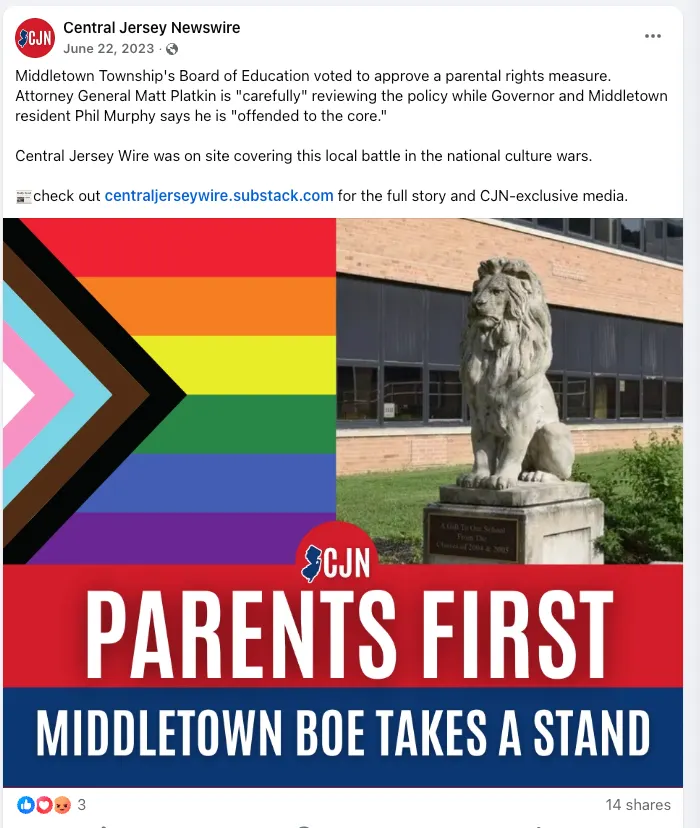
Once the links appeared on the Central Jersey Newswire page, they were then shared into a network of local Facebook groups, some focused on specific towns, others organized around local politics or regional issues. The shares often came from the same individual publicly associated as CJN’s editor. Often, the posts moved quickly into large community groups with thousands of members, where they blended in with everyday local news, event announcements, and neighborhood discussions.
Most posts on the CJN page receive roughly 10 to 20 shares within 24 hours, forming a modest but consistent distribution pattern.
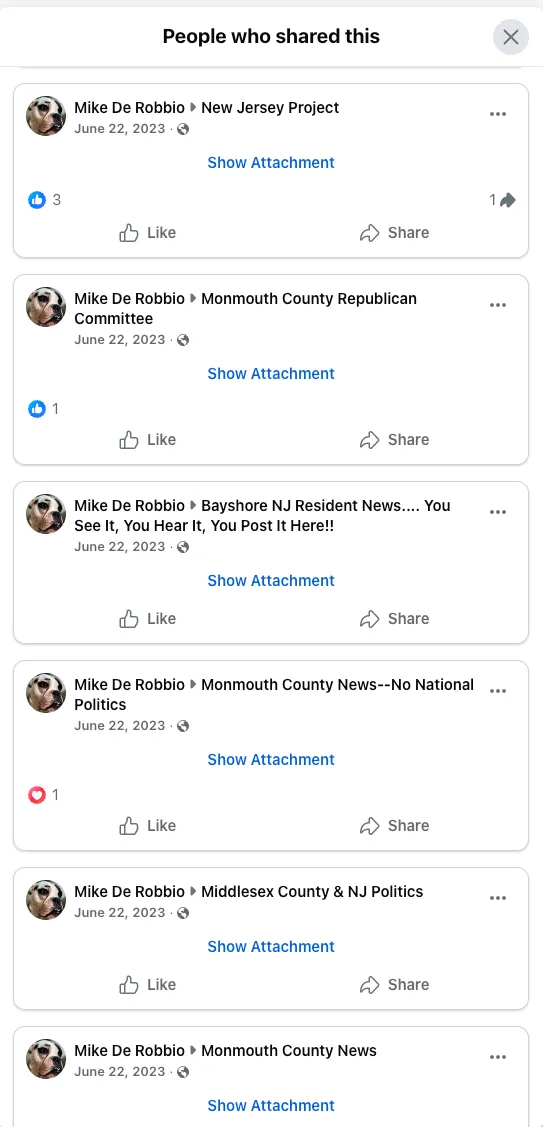
From the perspective of a Facebook user, the process was invisible. A link that originated on a digital outlet connected to a political consulting vendor appeared in their feed as a simple post from a community group or fellow resident. The pathway, publication on the website, posting on the CJN page, and redistribution through multiple groups, effectively broadened the reach of the articles far beyond the outlet’s direct audience.
This sequence of posting and resharing gave the content a second life, extending its visibility and positioning it within the social spaces where many residents get their daily local information. Without any disclosure of financial or organizational links, the articles appeared like ordinary news.
What This Reveals About Local Influence
Taken together, the publication and distribution patterns point to a system that operates outside traditional disclosure rules.
New Jersey law requires attribution on political communications when money is spent on election communications. But the combination of campaign-funded vendors, undisclosed media content, and group-based Facebook amplification operates in a space the law does not clearly address. To readers, the material appears as independent reporting shared organically by neighbors or community pages.
Nothing signals that the outlet publishing the content is connected to the same vendor receiving campaign payments.
This example does not establish intent. Instead, it illustrates how modern political communication can merge consulting, content creation, and targeted distribution in ways that make it difficult for the public to understand who is shaping the information they encounter.
Read the Full Research Report
This is one illustration from a broader, data-driven analysis of local political communication networks in Monmouth County.
Read the full report here: Mapping Influence and Information Flow: The Convergence of Party Spending and Political Media in Monmouth County
Supplemental Information
The most recent NJ ELEC financial disclosure for Jacqueline Tobacco is dated November 28, 2023. That filing reported campaign debt totaling $15,422.81. No subsequent filings have been submitted, and the status of the debt is unknown at the time of this publication.
The most recent NJ ELEC financial disclosure for Frank Capone is dated December 11, 2024. That filing reported a campaign balance of $2,271.50. On February 5, 2025, Capone filed a Form D-1 establishing a single-candidate committee for the 2026 election.
In March 2024, Frank Capone appeared on a Central Jersey Newswire moderated panel at the annual NJ GOP Convention.
In February 2025, appeals courts ruled against the Middletown Board of Education and upheld the legality of Policy 5756. Jacqueline Tobacco has stated publicly that the district incurred no expenses for its legal defense. This claim has not been independently verified.
Notes
- Robbio, Mike De. CJN Founder: Join Me in Atlantic City! https://www.centraljerseywire.com/p/cjn-founder-join-me-in-atlantic-city. Accessed 1 Nov. 2025.
- Central Jersey Newswire. About — Central Jersey Newswire. https://www.centraljerseywire.com/about. Accessed 1 Nov. 2025.
- Central Jersey Newswire. https://www.facebook.com/centralnjwire/. Accessed 1 Nov. 2025.