
Mapping Influence and Information Flow: The Convergence of Party Spending and Political Media in Monmouth County
Drawing on publicly available NJ ELEC and FEC records, this research traces more than $280,000 in campaign payments and identifies recurring timing patterns between vendor disbursements and favorable, undisclosed political coverage in Monmouth County.
An academic research report based on publicly available NJ ELEC and FEC data. Readers are encouraged to independently verify all findings.
Abstract
This study examines the intersection of financial coordination and informational influence within local political networks, using the Monmouth County Republican Committee (MCRC) in New Jersey as a case study. Drawing on publicly available campaign-finance disclosures and web-archived media content, the research maps payments to a shared vendor — Archangel Strategy Group LLC — and traces the temporal relationship between these disbursements and the publication of favorable political content on Central Jersey Newswire, a digital news outlet.
Manual content coding and temporal analysis reveal that payments to the vendor were consistently followed by emotionally framed articles that promoted MCRC-aligned candidates or criticized their opponents, without disclosure of any financial connection. These findings extend party-network theory by demonstrating that vendors serve not only as financial intermediaries but also as producers and distributors of partisan messaging.
The study highlights a regulatory gap within New Jersey’s campaign-finance framework (N.J.S.A. 19:44A-22.3), which requires attribution for paid political communications. As vendor-mediated media becomes a common instrument of political strategy, greater attention to the convergence of consulting, media production, and campaign communication is essential for understanding the evolving architecture of local political influence.
1. Introduction
Traditional campaign-finance research treats expenditures as isolated financial events. Yet in practice, each transaction represents a node in a wider network through which resources and narratives flow. At the local level, this flow can blur the boundary between formal party activity and ostensibly independent media.
The Monmouth County Republican Committee (MCRC) provides a salient case. Situated in one of New Jersey’s most competitive counties — with roughly 31 percent Republican, 29 percent Democratic, and 40 percent unaffiliated voters — the MCRC has historically outperformed its statewide partisan baseline.¹ The county voted Republican in every gubernatorial race since 2005 and leaned Republican in presidential elections as recently as 2020.² Understanding how such local dominance is maintained requires examining not only who pays whom but who shapes the public narrative.
This study therefore reframes campaign finance as information infrastructure. By mapping payments to vendors and tracing corresponding media outputs, it explores how political organizations coordinate messaging through shared intermediaries, potentially merging campaign operations with media production.
Under New Jersey law, any communication made to influence an election must include a clear “paid for by” statement identifying the sponsor responsible for the expenditure (N.J.S.A. 19:44A-22.3). This disclosure requirement applies to both direct campaign materials and independent expenditures funded by political committees. The statute’s intent is to promote transparency by allowing voters to identify the financial source behind persuasive messages. Within this framework, undisclosed political content — particularly when financially linked to campaign entities — raises questions about both regulatory compliance and the integrity of local information ecosystems.
2. Literature Review
2.1 From Party Organizations to Party Networks
Political parties are increasingly understood not as rigid hierarchies but as interconnected networks of actors who collaborate to achieve shared electoral and ideological goals. Scholars describe these “extended party networks” as encompassing not only formal party committees but also donors, consultants, advocacy groups, and media intermediaries that contribute resources, expertise, and communication capacity toward common partisan objectives.³ This perspective reframes parties as coalitions of coordinated actors operating both within and beyond official institutional boundaries, highlighting the distributed nature of influence and strategy in modern politics.
2.2 Vendors as Information Intermediaries
Within these extended networks, vendors play a pivotal yet often overlooked role. While donor networks have received substantial scholarly attention, research on political vendors remains limited. Kimball and Wilcox identify vendors as “horizontal integrators,” entities that transfer strategic expertise, data, and messaging assets among multiple campaigns within the same partisan sphere.⁴ Similarly, Masket demonstrates that consultants frequently act as brokers of ideological coherence — aligning narrative, tone, and tactics across candidates and committees.⁵ These findings suggest that vendors may function not merely as service providers but as organizational conduits, facilitating the exchange of strategy and message coordination across campaigns.
2.3 Information Flow and Local Media
A parallel literature explores partisan media ecosystems, showing how ideologically aligned outlets amplify narratives through coordinated dissemination. Faris et al. document how digital media networks reinforce political identity and frame discourse by selectively amplifying stories favorable to their side.⁶ However, few studies directly connect these media ecosystems to campaign-finance activity or vendor relationships, particularly at the county or municipal level, where information networks are less visible but often more influential. This gap underscores the need to investigate how local party structures, through shared vendors or intermediaries, may sustain partisan communication networks that blur the line between journalism and campaign messaging.
2.4 Emotional Framing and the Spread of Political Information
The circulation of political information depends not only on exposure but also on its emotional resonance. Research consistently shows that misinformation and partisan narratives exploit affective cues — especially anger, distrust, and moral outrage — to drive engagement and diffusion.⁷ Zaeem et al. identify a strong association between negative sentiment and false news, while other studies find that emotionally charged content spreads more rapidly and endures longer than neutral information.⁸ During crises such as the COVID-19 pandemic, public anger correlated with the sharing of unverified rumors, further reinforcing the link between emotion and virality.⁹
In political contexts, these dynamics interact with motivated reasoning — the tendency for individuals to accept emotionally congruent information that reinforces their partisan identity.¹⁰ Such framing intensifies both belief and dissemination, as outrage and affirmation strengthen group cohesion. In the present study’s context, Central Jersey Newswire articles temporally linked to vendor payments often exhibit these emotional features — anger, grievance, or vindication — consistent with research showing that emotion operates as a mechanism of persuasion and mobilization. This suggests that emotionally framed narratives, strategically timed with vendor disbursements, may serve as tools of affective coordination within local political networks.
2.5 Gaps in Knowledge
Despite the expanding literature on party networks and political communication, three significant gaps remain:
- Vendor-level coordination: Local political vendors are rarely analyzed as communication hubs that connect multiple committees and campaigns.
- Temporal coupling: Research seldom links the timing of campaign expenditures to the production or release of partisan media content.
- Disclosure and transparency: Few studies examine how undisclosed financial or organizational ties between campaigns and media outlets influence public perception of independence.
This study addresses these gaps by combining financial network analysis with media-content tracing to examine how local political organizations coordinate both monetary and informational resources through shared vendors.
3. Research Question and Hypothesis
This study originated from an exploratory observation within publicly available campaign-finance records. Repeated disbursements from multiple political committees to Archangel Strategy Group LLC prompted an inquiry into the firm’s broader role in local campaign activity. Subsequent background research indicated that the company’s principal was also associated with a regional digital outlet, Central Jersey Newswire, which published content consistently aligned with those committees’ interests.
This pattern suggested a potential linkage between financial transactions and informational outputs, motivating a structured investigation into how local party networks coordinate spending and messaging through shared vendors.
Research Question:
How do county party committees and local candidates coordinate financial and informational resources through shared vendors, and what observable patterns indicate the existence of such coordinated networks?
Hypothesis (H₁):
When county party committees and affiliated candidates employ the same communications vendor, payments to that vendor will coincide temporally with the publication of favorable, undisclosed media content promoting the payer’s interests. This relationship reflects an integrated flow of financial and informational resources, suggesting coordinated campaign activity operating through a common vendor network.
4. Methods
4.1 Data Sources
This study draws exclusively on publicly available data from three primary sources.
The first dataset comprises campaign-finance disclosures published by the New Jersey Election Law Enforcement Commission (NJ ELEC). These records contain itemized contribution and expenditure reports filed by registered political committees and are available for direct download through the agency’s public portal.
The second dataset comprises campaign-finance disclosures published by the Federal Election Commission (FEC). These records contain itemized contribution and expenditure reports filed by registered political committees and are available for direct download through the agency’s public portal.
The third dataset was derived from the public website of Central Jersey Newswire, a digital outlet producing local and political reporting. Article data were collected from the site’s public sitemap and corresponding pages to create a corpus of published content for analysis.
No restricted or personally identifiable information was accessed. All analyses were conducted on data within the public domain.
4.2 Data Identification
The relationship between Archangel Strategy Group LLC and Central Jersey Newswire was identified through cross-referencing public business filings, campaign-finance reports, and online domain ownership records.
Itemized expenditure data from the NJ ELEC filings listed repeated vendor payments describing services such as Digital Marketing, Direct Mail Production, Political Consulting, and Website Development. Review of business registration documents revealed that the principal of the vendor shares the same name as the founder and editor of Central Jersey Newswire,¹¹ a digital outlet, with “over 47,000 subscribers”, describing itself as “an independent outlet dedicated to providing the news and opinions Main Street New Jersey deserves”.¹² This overlap formed the empirical basis for linking campaign expenditures to associated media activity.
4.3 Data Collection and Preprocessing
Campaign-finance records were exported directly from the NJ ELEC and FEC portals using defined queries for relevant political committees and candidates. Each export was labeled by query and date of retrieval and preserved to maintain provenance.
Subsequent preprocessing was conducted using Python scripts developed for this study. These scripts parsed and normalized tabular fields (e.g., date, sender, recipient, amount, purpose) into a standardized schema aligned with NJ ELEC’s reporting structure.
For the CJN corpus, article URLs were identified via the site’s publicly accessible sitemap XML. Metadata — including title, author, publication date, and summary text — were extracted automatically and compiled into a structured CSV dataset.
All preprocessing was performed in a reproducible environment using open-source tools. Code and non-sensitive datasets are available in the public GitHub repository accompanying this paper.
4.4 Interpretive Coding
To examine relationships between campaign expenditures and media narratives, all Central Jersey Newswire articles were manually reviewed and coded by the researcher according to sentiment toward identifiable candidates or political entities. Sentiment was classified as favorable, negative, or neutral, based on the textual and visual presentation at the time of review.
Campaign-finance reports were filtered to campaigns with listed expenses to the vendor and candidates that received favorable coverage from the outlet.
The coding framework was developed inductively during preliminary analysis and applied consistently across the dataset. Aggregated coding results are summarized in the Results section.
4.5 Temporal Context and Web Archiving
Because online news content can change over time, all analyses reference the content as it appeared on the recorded capture date. Archival snapshots were preserved to ensure the reliability and verifiability of observations. Where applicable, URLs and timestamps are included to enable independent replication of findings.
4.6 Ethical and Legal Considerations
All materials analyzed were publicly accessible at the time of collection. No private communications, restricted documents, or personal data were solicited or obtained. The research adheres to established standards for open-data scholarship and digital investigative research, emphasizing transparency, reproducibility, and respect for privacy.
The study distinguishes between factual information verifiable through public records and interpretive assessments explicitly attributed to the author. Web archiving was employed both to preserve evidentiary context and to support future validation of the findings.
4.7 Reproducibility and Data Availability
All data processing scripts, schema definitions, raw NJ ELEC and FEC exports, and derived datasets are provided in the accompanying GitHub repository under an open-source license. Each dataset includes metadata describing its origin, collection date, and processing steps.
Detailed replication instructions — including environment setup, dependencies, and command-line usage — are provided in the repository’s README file to ensure full reproducibility of the analytical workflow.
All data are verifiable through NJ ELEC and FEC public records; readers and journalists are encouraged to independently reproduce or extend these findings.
5. Results
5.1 Descriptive Overview
Between January 1, 2023, and November 5, 2025, the Monmouth County Republican Committee (MCRC) issued 39 payments totaling $84,546.10 to Archangel Strategy Group LLC. Other campaigns and affiliated committees collectively issued 79 payments totaling $198,208.47 to the same vendor, indicating that vendor operated as a shared service provider across multiple Republican campaigns in Monmouth County. In total, the vendor received 118 payments amounting to $282,754.57 during the study period. The list of all campaigns and committees included in this analysis is provided in Appendix A (Table A1).
Within this timeframe, Central Jersey Newswire published 185 articles referencing MCRC-endorsed candidates. Of these, 126 articles (68%) were coded as favorable in tone, and 67 articles (36%) were published within 21 days of a payment from either the candidate or a supporting committee. The close temporal alignment between vendor disbursements and favorable editorial output suggests a recurring pattern of financial–informational coordination between campaign entities and affiliated media.
5.2 Financial Flow Visualization
Figure 1 visualizes the flow of financial transactions among the Monmouth County Republican Committee (MCRC), affiliated candidate committees, and the shared vendor between January 2023 and November 2025. The diagram depicts committees as source nodes, MCRC as a central intermediary, and aggregated payment values as proportional flow widths.
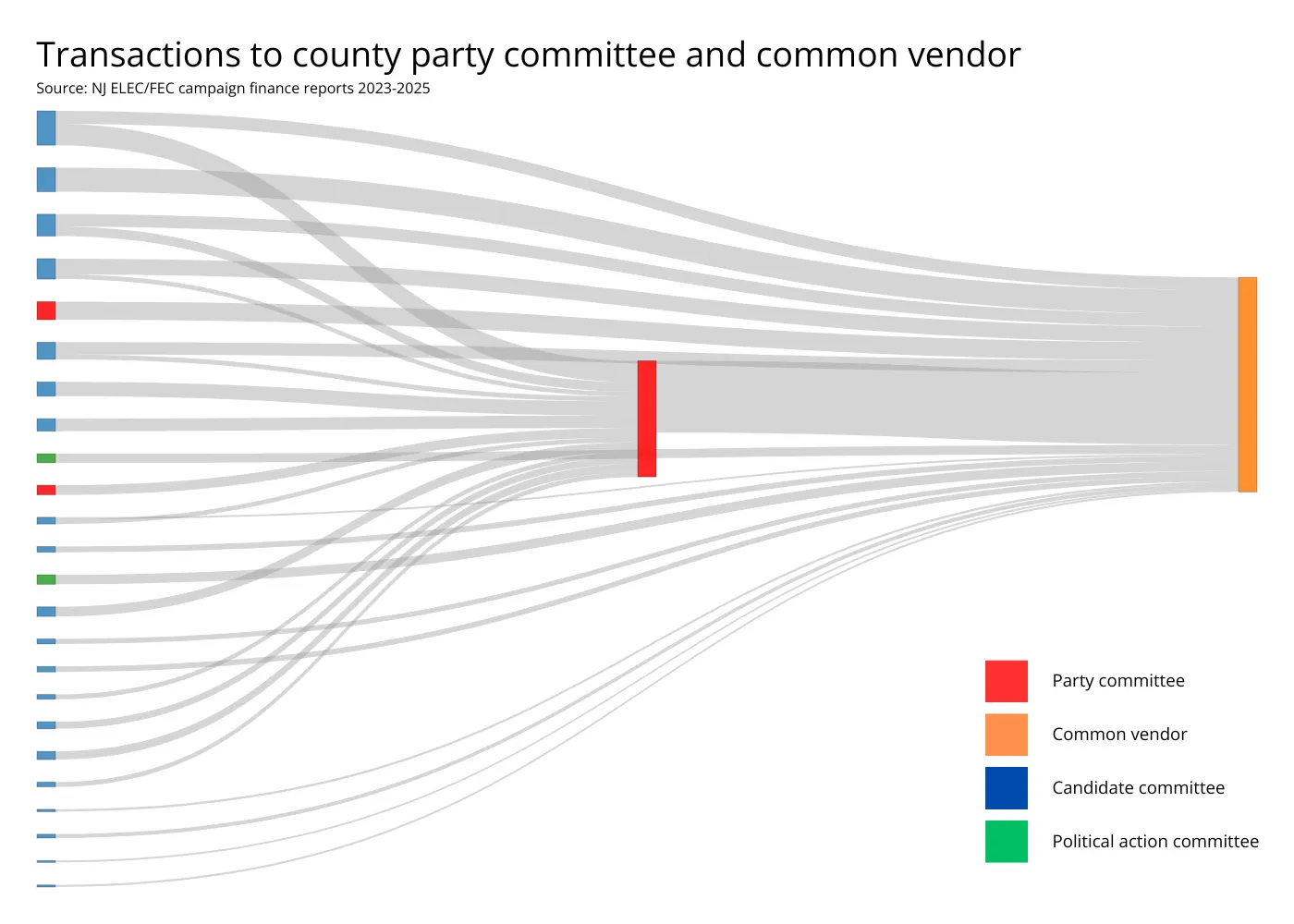
The visualization highlights MCRC’s role as the dominant funding source, accounting for nearly half of total payments to the vendor, while additional inflows from multiple candidate committees demonstrate the vendor’s cross-campaign integration. The convergence of financial paths into a single vendor node underscores the vendor’s position as a network hub within the county’s political infrastructure — serving simultaneously as a recipient of campaign funds and a potential channel for coordinated messaging activity.
5.3 Candidate-Level Associations
Figure 2 summarizes candidate-level associations between direct payments to the vendor and the number of favorable mentions identified in the outlet during the study period.
The pattern indicates that candidates with larger payments generally correspond to greater volumes of favorable coverage.
5.4 Representative Transactions and Corresponding Articles
Table 1 presents a representative subset of transactions linking campaign payments to articles published within 21 days of disbursement.
These representative cases illustrate recurring temporal proximity between financial transactions and favorable coverage, often within a one- to two-week window.
5.5 Case Illustration: Temporal Coupling of Payments and Editorial Output
Across multiple election cycles, editorial content on Central Jersey Newswire that promoted MCRC-aligned candidates — or targeted their opponents — consistently appeared within days of payments to the same shared vendor. The following examples illustrate how these financial and informational flows align temporally and substantively.
On July 19, 2023, Paul Kanitra’s campaign paid $2,000 to the vendor for “digital consulting.” The next day, the outlet published “WATCH: Mayor Kanitra TORCHES Gov. Murphy, Democrats on electric vehicle mandate in new ad” (link), an article amplifying Kanitra’s campaign message through favorable framing and emotionally charged language.
On October 22, 2023, Frank Capone’s campaign reported a $500 payment to the vendor for “Internet services.” Two days earlier, the outlet had published “We Need to Talk About Justin Meehan” (link), a sharply negative piece attacking Capone’s opponent. The close proximity of the payment and the partisan tone of the coverage suggest coordinated narrative targeting facilitated by the vendor.
A similar sequence occurred in April 2024, when Declan O’Scanlon’s committee paid $1,500 to the vendor for “digital consulting” on April 5. Four days earlier, the outlet released “O’Scanlon Declares Victory! Rutgers finally lifts COVID vaccine requirement…two years too late” (link), presenting O’Scanlon as vindicated on a key policy issue.
Later that year, on September 27, 2024, the outlet published “Bashaw, Fegler Torch Democrats Supporting Illegal Sex Offenders”, a highly favorable article spotlighting Scott Fegler and Curtis Bashaw. Within a week, Fegler’s campaign paid $3,000 to the vendor for “media services.”
The pattern extended into the 2025 election cycle. On May 23, 2025, the Monmouth County Republican Committee paid $2,086.55 to the vendor for “telemarketing/robocalls — text messages.” Two weeks later, the outlet published “Bellomo Voted Against Investigation into Board Response to Alleged Molestation and Legal Malpractice” (link), a piece attacking a candidate opposing the MCRC-backed slate.
Across these cases, payments to the vendor were followed — typically within one to two weeks — by editorial content that either elevated the paying candidate or discredited an opponent, without disclosure of any financial or organizational connection between the outlet and the vendor. Collectively, these findings are consistent with the interpretation that the vendor functioned as both a financial and informational conduit, aligned partisan messaging through an affiliated media platform that presented itself as an independent local news source.
5.6 Summary of Findings
The results reveal a consistent temporal and structural relationship between campaign payments and the publication of favorable editorial content. Across three election cycles, the vendor emerged as a central node linking financial expenditures by multiple campaigns to coordinated informational outputs on the outlet. Payment clusters were frequently followed by emotionally framed articles supporting the paying candidate or criticizing opponents, without disclosure of any organizational or financial connection. These findings suggest the presence of an integrated network of financial and informational coordination, in which vendor relationships serve as conduits for both monetary flow and narrative influence within local political ecosystems.
6. Discussion
6.1 Financial and Informational Integration
The findings support the hypothesis that vendors operate as information intermediaries within local party networks. In this case, the vendor appears to function not merely as a consultant but as a conduit linking campaign-finance activity to coordinated media outputs. Payments were often followed within days by favorable or adversarial coverage on Central Jersey Newswire, indicating a degree of temporal coupling inconsistent with purely transactional vendor relationships. These results demonstrate how financial flows can simultaneously enable and obscure the correlation of political narratives, revealing an integrated system of resource exchange that blends campaign strategy with message production.
Industry estimates for newsletter sponsorship rates suggest that paid placements in Substack or comparable email-based publications typically command a cost of $10 to $50 per thousand subscribers (CPM), depending on engagement and audience quality.¹³ A 2024 analysis of newsletter sponsorships reported an average CPM of roughly $35, consistent with broader ranges for mid-tier creators.¹⁴ Applying this range to a Substack with approximately 50,000 subscribers yields an expected cost of $500–$2,500 per sponsored post. This aligns closely with observed campaign payments of $2,500 associated with the publication of three to four articles, reinforcing that such transactions are consistent with market-rate promotional spending rather than atypical or extraordinary expenditures.
6.2 Implications for Party-Network Theory
This case extends the concept of the “extended party network” by making message production and dissemination measurable outcomes of financial coordination. Rather than operating as discrete actors, local committees, candidates, and vendors appear to function as nodes in a hybrid information infrastructure — one that merges consulting, communications, and partisan media under shared operational control. The observed temporal and narrative alignments suggest that party-network theory must account not only for financial interdependence but also for informational convergence, where vendors actively shape the content environment in which campaigns compete.
6.3 Disclosure and Public Transparency
None of the articles identified in this study contained disclosures acknowledging financial or organizational ties between Central Jersey Newswire and the campaigns or vendor involved — despite such relationships being material to a reader’s interpretation of independence. Under N.J.S.A. 19:44A-22.3, any communication intended to influence an election must include a clear “paid for by” statement identifying its sponsor. The absence of such attribution, particularly when content is temporally associated with campaign payments, situates this activity in a regulatory gray zone between campaign speech and journalism. This aligns with concerns raised by Faris et al. regarding partisan media ecosystems, wherein political advocacy is increasingly embedded within outlets that emulate independent news.¹⁵
The findings also carry implications for regulatory interpretation and enforcement under New Jersey’s campaign-finance law. If a vendor financially linked to political committees is involved in producing or distributing persuasive content without disclosure, such material may raise interpretive questions about whether such material would meet the statutory definition of paid political communication. While this study does not evaluate intent or legal liability, the observed pattern raises normative questions about how effectively existing disclosure rules capture vendor-mediated political advertising.
6.4 Limitations and Future Research
Several limitations qualify these findings.
First, the analysis relies exclusively on publicly accessible records; undisclosed subcontracting, off-platform coordination, or miscategorized campaign expenses may extend the network beyond observable transactions. Second, manual content coding, while systematic, remains interpretive and could be augmented through automated sentiment or topic modeling to improve scalability. Finally, comparative research across counties and parties would clarify whether vendor-mediated coordination represents a broader structural feature of local party systems or a partisan-specific strategy.
7. Conclusion
This research contributes empirically to the study of local party networks by operationalizing vendor relationships as measurable points of informational correlation. By linking campaign-finance data from the Monmouth County Republican Committee (MCRC) to the publication of favorable editorial content on Central Jersey Newswire, the analysis reveals an integrated system in which vendors facilitate both monetary transactions and narrative production.
These findings extend party-network theory by illustrating how message creation functions as a tangible output of financial collaboration. They also expose a transparency gap within existing disclosure regimes: vendor-mediated content can influence elections while evading the “paid for by” requirements of N.J.S.A. 19:44A-22.3.
While it remains possible that the identified transactions represent routine campaign expenditures unrelated to specific editorial outputs, the undisclosed overlap between the vendor, the party organization, and a politically aligned media outlet nonetheless raises ethical and transparency concerns. Even in the absence of direct payment for coverage, such entanglements blur the distinction between campaign communication and journalism, underscoring the need for clearer disclosure standards within local political ecosystems.
As campaigns increasingly operate through hybrid infrastructures that merge consulting, media, and messaging, regulatory frameworks and political communication research must evolve to account for these blurred boundaries between party organization, commercial enterprise, and public information.
Appendix
Appendix A. Campaigns and Committees Included in Analysis
Notes on Table A1 Data
Table A1 lists the campaign and committee entities included in this analysis as they appear in New Jersey Election Law Enforcement Commission (NJ ELEC) filings. The Committee ID and Committee Name fields are shown exactly as entered in the NJ ELEC system at the time of data collection.
Minor variations in naming (e.g., ABERDEEN TOGETHER vs. ABRDEEN TOGETHER) reflect inconsistencies in how filers reported their entities. These identifiers are preserved verbatim to maintain fidelity to the public record and allow direct cross-verification in the NJ ELEC database.
© 2025 Public Record NJ. This work is licensed under a Creative Commons Attribution–NonCommercial 4.0 International License.
Readers, journalists, and researchers may share or adapt this material for non-commercial purposes, provided that proper attribution is given and any modifications are clearly indicated.
When citing this research, please use the following attribution:
Public Record NJ (2025). “Mapping Influence and Information Flow: The Convergence of Party Spending and Political Media in Monmouth County.” Published on Medium, https:/www.publicrecordnj.com/research/mapping-influence-and-information-flow-the-convergence-of-party-spending-and-political-media-in-monmouth-county/
Notes
- “Monmouth County, New Jersey,” Wikipedia, 23 Sept. 2025, https://en.wikipedia.org/wiki/Monmouth_County,_New_Jersey
- New Jersey Department of State, Official General Election Results — Monmouth County, 2005–2024, https://www.nj.gov/state/elections/election-information-results.shtml
- Kathleen Bawn et al., “Organizations and the Party in the Electorate,” American Political Science Review 108, no. 3 (2014): 573–593.
- David C. Kimball and Clyde Wilcox, “Consultants and Coordination in State Legislative Campaigns,” American Politics Research 48 (2020): 654–676.
- Seth E. Masket, No Middle Ground: How Informal Party Organizations Control Nominations and Polarize Legislatures (Ann Arbor: University of Michigan Press, 2009).
- David Faris, Yochai Benkler, and Robert Faris, Network Propaganda: Manipulation, Disinformation, and Radicalization in American Politics (New York: Oxford University Press, 2018).
- Zainab Ashfaq et al., “Emotional Detection for Misinformation: A Review,” Information Fusion 112 (2024): 10230, https://doi.org/10.1016/j.inffus.2024.102300
- Muhammad Zaeem et al., “Fake News and Sentiment: Statistical Correlations Between Negativity and Falsehood,” cited in Ashfaq et al., “Emotional Detection for Misinformation”; Soroush Vosoughi, Deb Roy, and Sinan Aral, “The Spread of True and False News Online,” Science 359, no. 6380 (2018): 1146–1151.
- Xiaoyan Zhang et al., “Emotion and Rumor Spread During the COVID-19 Epidemic,” Information Processing & Management 58, no. 6 (2021): 102714.
- Brendan Nyhan and Jason Reifler, “When Corrections Fail: The Persistence of Political Misperceptions,” Political Behavior 32 (2010): 303–330; Jonathan Haidt, The Righteous Mind: Why Good People Are Divided by Politics and Religion (New York: Pantheon, 2012).
- Robbio, Mike De. CJN Founder: Join Me in Atlantic City! https://www.centraljerseywire.com/p/cjn-founder-join-me-in-atlantic-city. Accessed 1 Nov. 2025.
- Central Jersey Newswire. About — Central Jersey Newswire. https://www.centraljerseywire.com/about. Accessed 1 Nov. 2025.
- Start and Grow Substack. “The Most Effective Paid Ads Approach for 2024.” Start and Grow, Substack, accessed November 10, 2025. https://startandgrow.substack.com/p/the-most-effective-paid-ads-approach.
- The Newsletter Newsletter. “How Much Do Newsletter Sponsorships Cost?” The Newsletter Newsletter, Substack, February 12, 2024. https://thenewsletternewsletter.substack.com/p/cost-of-sponsorships-across-various.
- David Faris et al., Network Propaganda: Manipulation, Disinformation, and Radicalization in American Politics (New York: Oxford University Press, 2018).