
New Lawsuit Raises Questions About Partisan Influence in the Middletown BOE
A newly filed lawsuit alleges political retaliation, misuse of public records, and undisclosed coordination between campaign consultants and a local media outlet, raising questions about partisan influence inside a public school district.
A civil lawsuit filed in Monmouth County raises unresolved questions about whether partisan conflict within a school board was directed at a long-time teacher, shifting focus away from education and eroding public confidence in district governance.
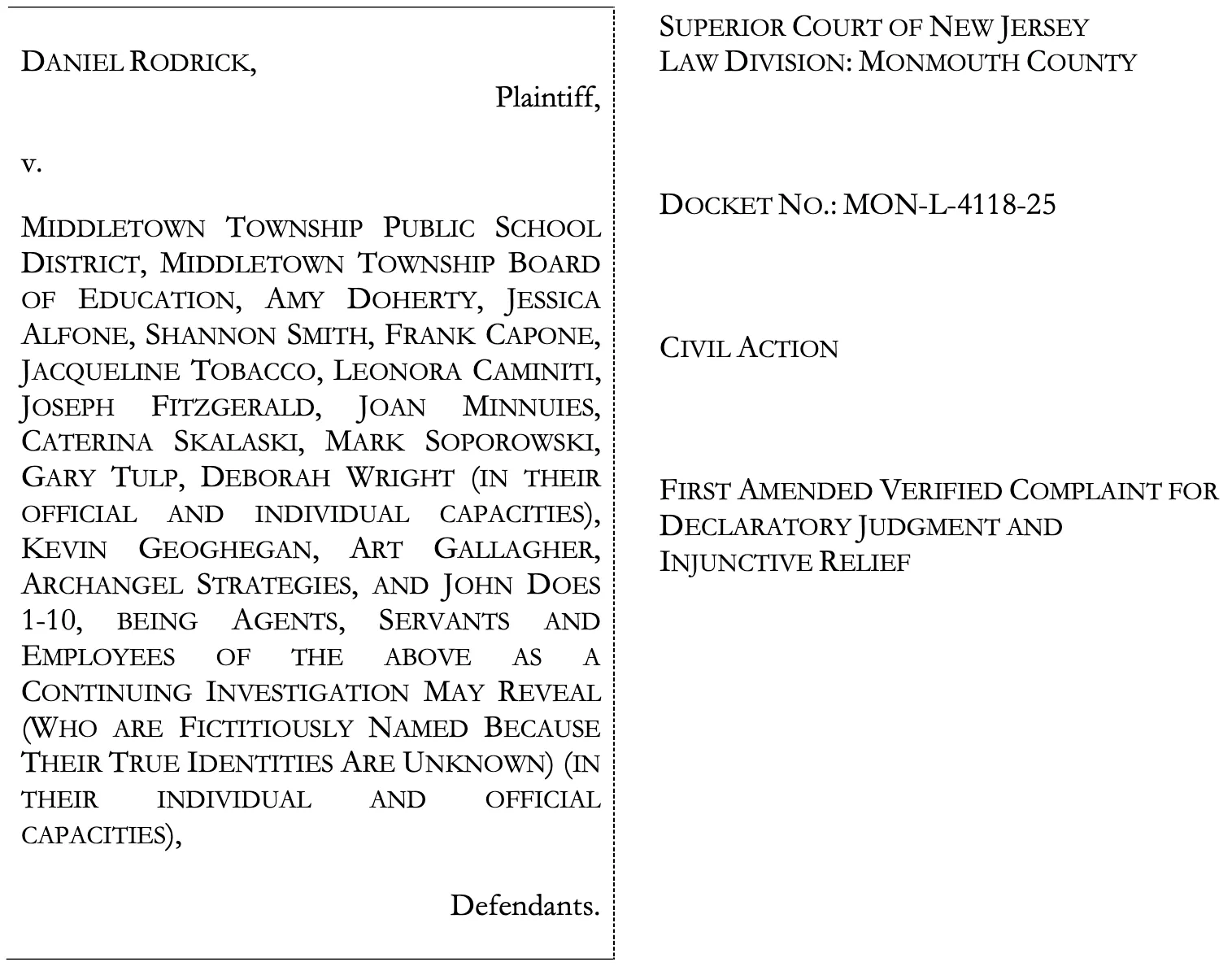
The case1, brought by Daniel Rodrick against the Middletown Township Public School District and Board of Education, centers on allegations of political retaliation, misuse of public records, and the coordination of undisclosed political content published by Central Jersey Newswire. A consulting firm, Archangel Strategy Group LLC, is named as a defendant and is alleged to have played a role in preparing or facilitating content that contributed to media coverage critical of Rodrick.
At a hearing held on January 30, 2026, the court declined to grant emergency relief and also declined to dismiss the case, allowing the case to proceed through the normal litigation process.
What the Complaint Alleges
Employment Action, Political Disputes, and the Use of Public Records
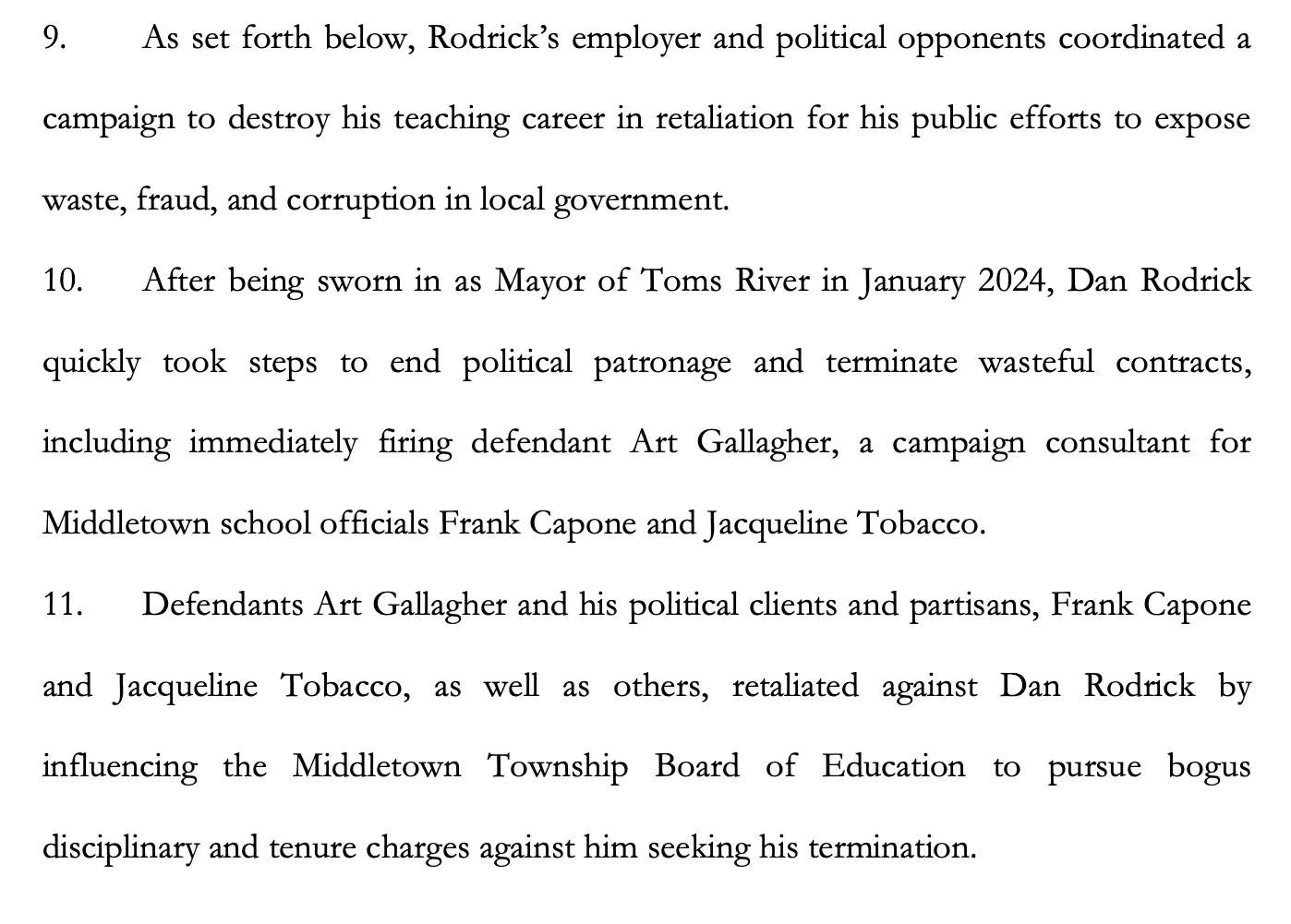
According to the Verified Complaint, Daniel Rodrick, a public school teacher who also serves as the mayor of Toms River, alleges that he was suspended from his teaching position and subjected to tenure charges2 following political and public-policy disputes related to actions he took as mayor. The complaint alleges that after assuming office in January 2024, Rodrick terminated certain municipal contracts, including the contract of an individual who also served as a campaign consultant for members of the Middletown Township Board of Education. Rodrick alleges that following these actions, he was removed from the classroom and placed on unpaid suspension through the filing of tenure and disciplinary charges, which were later withdrawn without his consent.
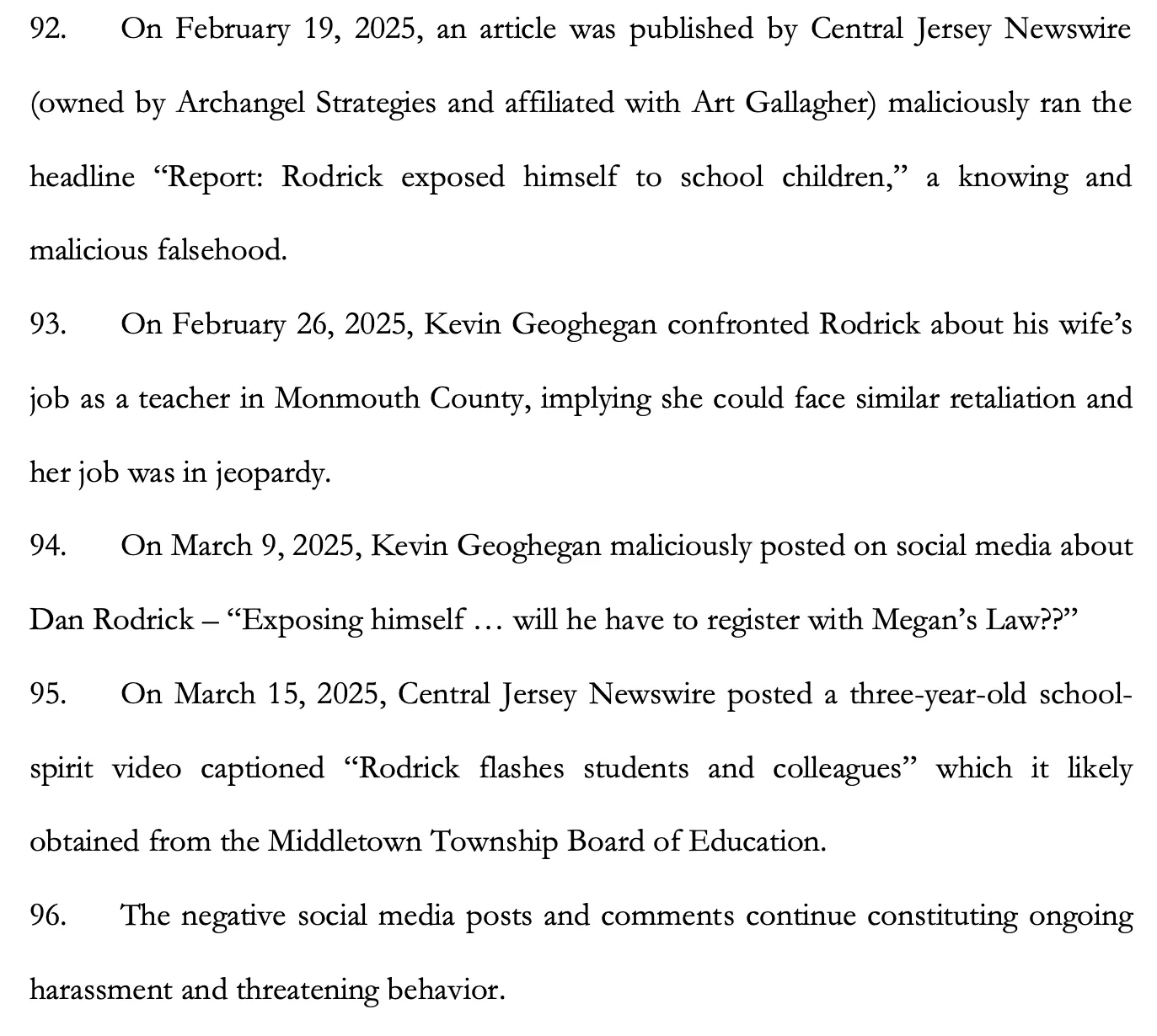
The complaint further alleges that information from Rodrick’s personnel file and materials responsive to public records requests were disseminated and used to generate media coverage critical of him, including articles published by Central Jersey Newswire. The filing alleges that Archangel Strategy Group acted as an intermediary by preparing, transmitting, or coordinating content that later appeared as news articles without disclosure of any political or financial sponsorship.
According to the complaint, this activity occurred during periods of heightened political conflict and reflected campaign-related themes. Rodrick alleges that the withdrawal of the tenure charges was followed by a refusal to reinstate him or provide back pay and benefits, in violation of statutory, constitutional, and common-law protections.
With the allegations now set out in sworn filings, the focus shifts from what is claimed to how the court has addressed those claims at the earliest stage of the litigation.
What Happened in the Hearing
The Court Declines Emergency Relief and Allows the Case to Proceed
At the January 30, 2026 hearing, the court addressed both the plaintiff’s request for an Order to Show Cause seeking expedited relief under the Open Public Records Act and common-law access doctrines, and the defendants’ cross-motion to dismiss portions of the complaint. The court denied both motions without prejudice.
The denial of the Order to Show Cause reflects the court’s decision not to intervene on an emergency basis at this stage, while expressly preserving the plaintiff’s ability to renew OPRA requests or seek future relief if warranted. The court also denied the defendants’ motion to dismiss Counts One and Two of the complaint, allowing those claims to proceed through the normal litigation process.
The case has been assigned to Case Track III3, which governs discovery timelines for whistleblower and retaliation matters. A case management conference is scheduled for March 10, 2026, at 3:00 p.m., at which the court is expected to address scheduling, discovery, and procedural next steps.
The court did not rule on the merits of the allegations or the conduct of any party. Those issues remain unresolved and will be addressed, if at all, through discovery and subsequent motion practice.
How the Allegations Align With Prior Campaign Spending and Media Activity
Patterns Previously Visible in Campaign Finance and Publication Timing
This alleged model mirrors patterns previously documented by Public Record NJ, in which campaign finance records show payments to Archangel Strategy Group by Frank Capone and Jacqueline Tobacco during a 2023 school board election marked by heightened partisan conflict. A similar dynamic surfaced in June 2025, when the Monmouth County Republican Committee appeared to act as a conduit between local officials and Turning Point USA, drawing Middletown into a broader national political debate.
The lawsuit names multiple individuals who have previously appeared in reporting on political messaging and media activity in Monmouth County, including figures associated with earlier coverage involving the Middletown Board of Education. While the complaint does not determine whether any published material was unlawfully coordinated, it alleges a recurring system in which political consulting, campaign strategy, and media publication operated in close alignment despite being formally distinct entities.
During the period in which Central Jersey Newswire published articles concerning Daniel Rodrick, Archangel Strategy Group received payments from several local campaigns and political organizations4, including the Monmouth County Republican Committee, Declan O’Scanlon’s legislative campaign, Tony Perry’s mayoral campaign in Middletown, and Erik Anderson’s campaign for Monmouth County Commissioner.

In addition to publishing articles critical of Rodrick, the outlet also published articles supportive of O’Scanlon and candidates endorsed by the Monmouth County Republican Committee. While these findings do not assert that the reported payments were connected to any specific articles or attacks, the timing and concentration of campaign spending alongside media publication highlight a close relationship between local party activity and the content appearing on the outlet.
Following the Money
Monmouth County Payments to an Out-of-State Opposition Research Firm
One detail that stands out is that the Monmouth County Republican Committee reported three payments to Malleus Political Strategies during the same period in which political attacks against Daniel Rodrick were occurring. Public campaign finance records indicate that this appears to be the only time in which the committee engaged this firm, and the first reported payments from any New Jersey campaign to Malleus Political Strategies since it was retained by the Republican Assembly Committee during the 2023 election cycle.

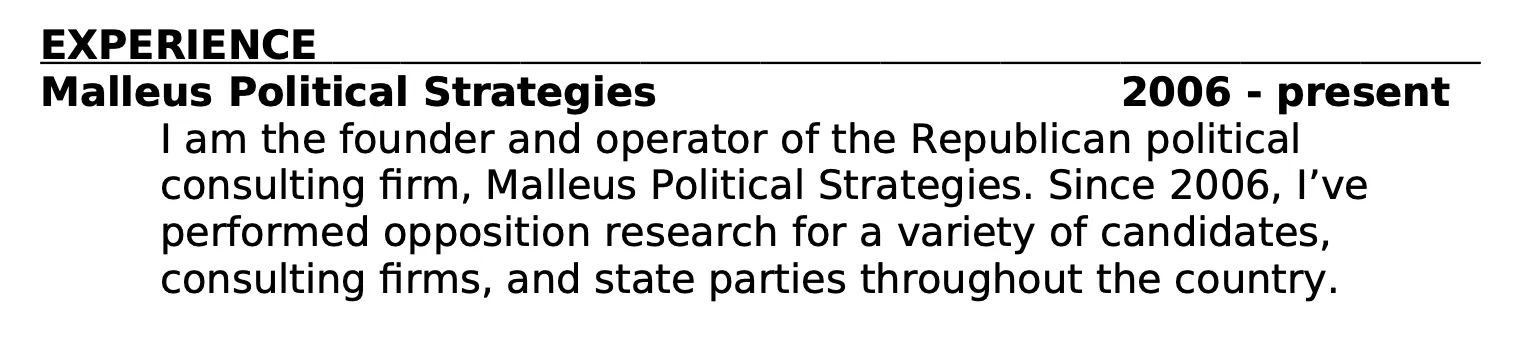
Malleus Political Strategies does not appear to maintain a public website, and limited information is found regarding its services. A publicly accessible résumé5 for Darren Eustance identifies him as the firm’s founder and describes his work conducting opposition research for political candidates, consulting firms, and state party organizations across multiple states. Eustance is a former candidate for North Carolina Secretary of State and previously served as chair of the Wake County, North Carolina Republican Party.
Social media posts from Eustance’s campaign account show him delivering a presentation on opposition research to the Wake County chapter of Moms for Liberty, in which he praised the group’s efforts to challenge local school board actions. The Southern Poverty Law Center describes Moms for Liberty as a far-right organization involved in campaigns against public health regulations for COVID-19, opposes LGBTQ+ and racially inclusive school curriculum, and has advocated books bans.6
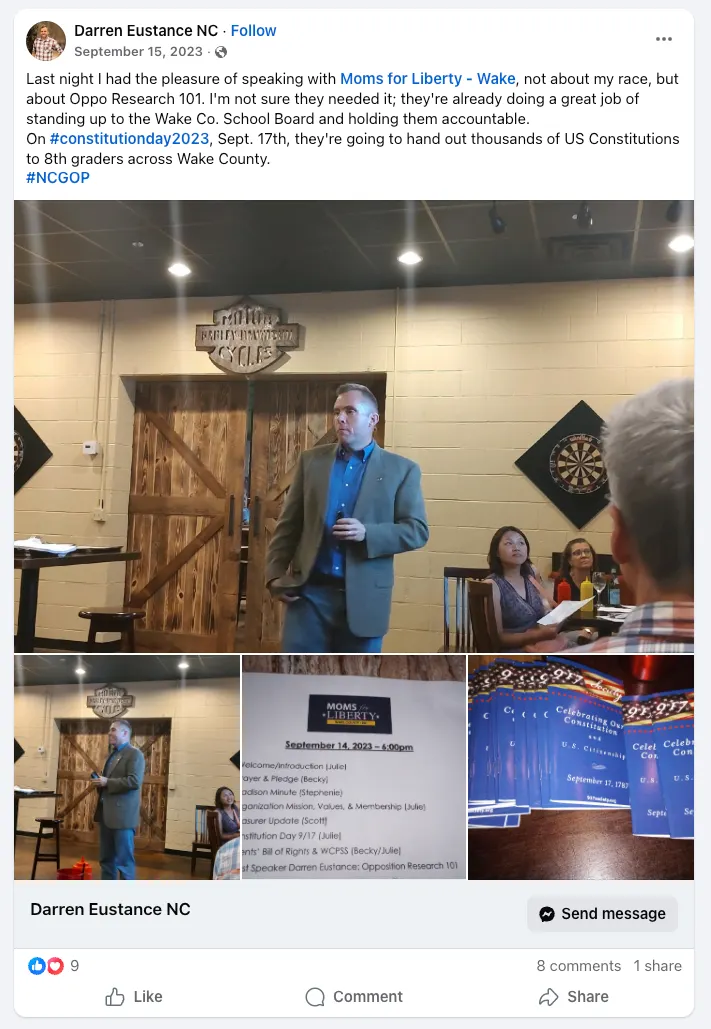
The relevance of the out-of-state opposition research firm lies in the political context of its work. The consultant has publicly aligned himself with national school-focused political movements whose priorities and tactics mirror the partisan school politics implicated in this case. Considered alongside the timing of the reported payments, this alignment raises questions about whether the services retained involved opposition research or strategic political messaging related to Rodrick. While those questions remain unresolved, they underscore why the payments warrant closer examination as part of the broader factual record.
Why This Matters
Disclosure Gaps, Public Power, and the Appearance of Independent Media
The issues raised in this lawsuit extend beyond the parties involved and go to the heart of how public education is governed. When partisan politics and alleged political retribution enter the operations of a school district, they do not remain abstract disputes. They consume administrative time, public funds, and institutional focus that would otherwise be directed toward classrooms, students, and educational outcomes.
The complaint describes a system in which employment decisions, access to public records, and media activity are allegedly shaped by political conflict rather than educational priorities. If true, such practices risk undermining public trust in nonpartisan school governance, destabilizing school leadership, and turning institutions designed to serve students into arenas for political combat.
The court’s rulings ensure that these allegations will now be examined through discovery rather than dismissed at the outset. Whether the claims are ultimately substantiated remains unresolved, but the process itself will place sustained scrutiny on how political power is exercised within public school systems and at what cost to students, educators, and taxpayers.
What Comes Next
Discovery, Case Management, and the Record Still to Be Built
With the denial of emergency relief, the case now proceeds under the court’s standard litigation schedule. Its assignment to Case Track III provides for an extended discovery period typical of whistleblower, retaliation, and related statutory claims. A case management conference scheduled for March is expected to establish discovery timelines and address the scope and sequencing of further proceedings.
Under Case Track III, discovery typically unfolds over many months rather than weeks. As a result, additional information about the employment actions at issue, the handling of public records requests, and the alleged dissemination of political messaging is unlikely to emerge immediately, but may develop gradually through document production, depositions, and subsequent motion practice.
Through discovery, the parties may seek records and testimony concerning Rodrick’s suspension, the filing and withdrawal of tenure charges, the refusal to reinstate him or provide back pay and benefits, and the handling of records under the Open Public Records Act and the common-law right of access. Discovery may also examine communications among consultants, political actors, and media outlets, including the origin and timing of articles published by Central Jersey Newswire.
Taken together, the court’s rulings indicate that the case will move forward on a deliberate timeline, with substantive developments emerging through discovery rather than in the immediate term. At a broader level, the litigation raises questions about how partisan political conflict can intersect with public school governance, and what that means for institutional trust, educational priorities, and the communities that fund and rely on public schools.
Read our Full Research Report
This lawsuit reflects themes examined in a broader, data-driven analysis of local political communication networks in Monmouth County.
Read the full report here: Mapping Influence and Information Flow: The Convergence of Party Spending and Political Media in Monmouth County
Notes
- Rodrick v. Middletown Township Public School District, Superior Court of New Jersey, Law Division, Monmouth County, Docket No. MON-L-004118–25 (filed 12 Nov. 2025).
- In New Jersey, tenure charges are formal disciplinary charges filed against a tenured public school employee alleging conduct that may warrant suspension or dismissal, and they trigger a statutory process that can include removal from active duty and adjudication before an administrative law judge.
- In New Jersey civil cases, Case Track III typically allows up to 450 days for discovery, reflecting the court’s expectation that complex matters will proceed over an extended timeline.
- Payment amounts were identified through publicly available New Jersey Election Law Enforcement Commission (ELEC) campaign finance filings covering the period from 1 Feb. 2025 through 31 Mar. 2025.
- The referenced material was identified through a Google search for “Malleus Political Strategies” performed on 2 Feb. 2026 and appeared within the first page of results at the time of review.
- Southern Poverty Law Center, “Moms for Liberty” organizational profile.