
How a Local Media Network Quietly Amplified Paul Kanitra’s Campaign
Campaign filings show payments to a political consulting firm whose principal is linked to a local news outlet that published favorable coverage during Paul Kanitra’s Assembly campaign, raising fresh questions about disclosure and influence.
Local political influence doesn’t always arrive through ads or mailers. Increasingly, it moves through digital outlets that appear to be independent news sources while publishing content that aligns with campaign interests. Our review of publicly available records shows how that dynamic played out in one recent race: a media outlet linked to a campaign vendor published and amplified favorable content about a candidate during an active election period, without any public disclosure of that relationship.
A closer look at the campaign of Paul Kanitra shows how these dynamics ultimately surfaced on residents’ newsfeeds.
The Network Behind the Content
As detailed in our research report, Mapping Influence and Information Flow: The Convergence of Party Spending and Political Media in Monmouth County, we examined campaign-finance records showing repeated payments to Archangel Strategy Group LLC. The vendor does not publicly describe the services it offers. However, itemized NJ ELEC filings list repeated payments under broad categories such as digital marketing, direct mail production, political consulting, and website development.
A review of business records indicates that the principal of Archangel Strategy Group LLC is the same individual publicly associated with Central Jersey Newswire as its founder and editor1.
Central Jersey Newswire is a Substack-hosted publication with more than 47,000 subscribers2 and an accompanying Facebook page with roughly 2,400 followers. The outlet describes itself as an independent journalism platform covering local and state issues, and it does not disclose receiving financial support from political campaigns.
Our analysis identified a recurring pattern between the timing of these vendor payments and the publication of related content on Central Jersey Newswire.
When the Money Moves and the Messages Follow
In February 2023, Point Pleasant Beach Mayor Paul Kanitra announced his candidacy for the New Jersey State Assembly in Legislative District 10. With the backing of the Monmouth County Republican organization, he won both the primary and the general election.
In June and July of 2023, Central Jersey Newswire published two articles spotlighting Kanitra as he campaigned for the Legislature:
- June 29: “WATCH: Shore Mayor SLAMS Budget Committee over offshore wind bailout.”
- July 20: “WATCH: Mayor Kanitra TORCHES Gov. Murphy, Democrats on electric vehicle mandate in new ad.”
Both pieces used emotionally charged framing, promoted Kanitra’s political message, and appeared during an active campaign period. Neither article contained any disclosure about financial or organizational ties.
During the same period, Kanitra’s campaign made two payments to Archangel Strategy Group LLC, categorized as website or computer consulting:
- July 10: $3,774
- July 19: $2,000
Our research does not establish intent behind the transactions, but the undisclosed relationship between the campaign, vendor, and the media outlet raises broader ethical concerns about transparency in local political communication.
How the Narrative Reached Voter’s Newsfeeds
After each article was published on the Central Jersey Newswire website, the outlet posted the links to its public Facebook page. These posts served as the starting point for a much larger distribution pathway that most readers would not see.
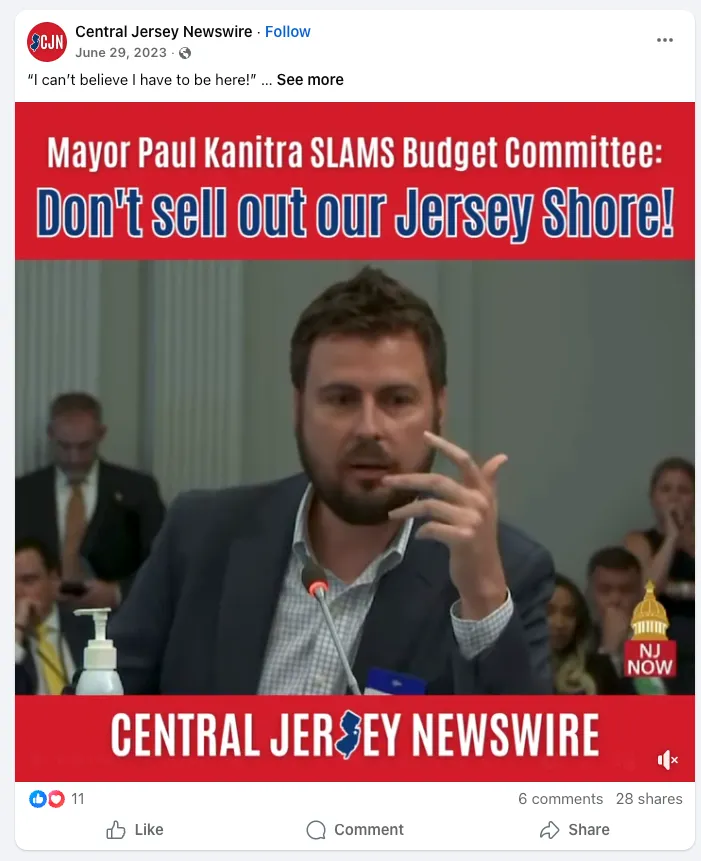
Once the links appeared on the Central Jersey Newswire page, they were then shared into a network of local Facebook groups, some focused on specific towns, others organized around local politics or regional issues. The shares often came from the same individual publicly associated as CJN’s editor. Often, the posts moved quickly into large community groups with thousands of members, where they blended in with everyday local news, event announcements, and neighborhood discussions.
Most posts on the CJN page receive roughly 10 to 20 shares within 24 hours, forming a modest but consistent distribution pattern.
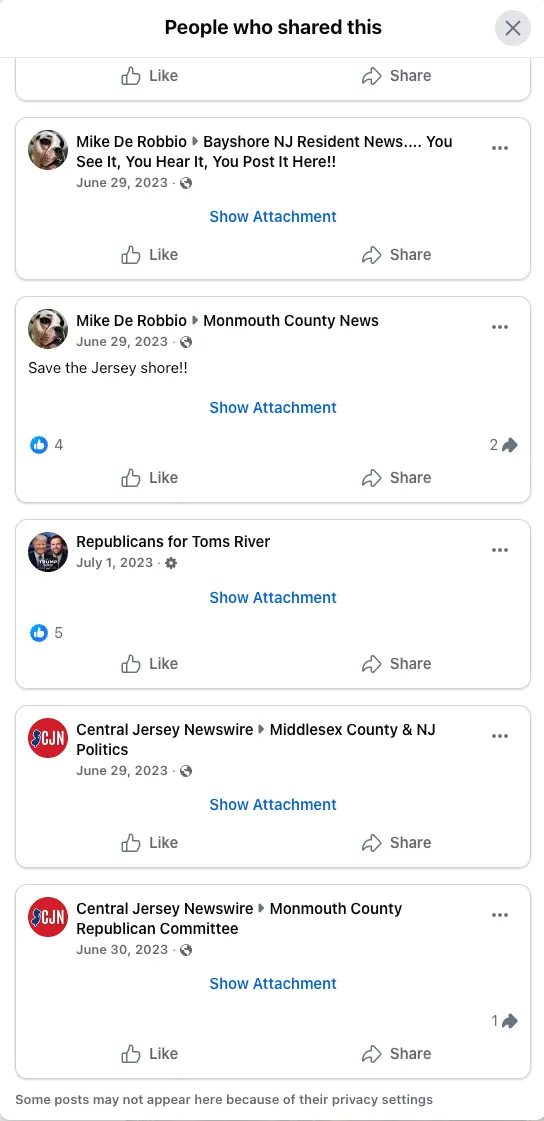
From the perspective of a Facebook user, the process was invisible. A link that originated on a digital outlet connected to a political consulting vendor appeared in their feed as a simple post from a community group or fellow resident. The pathway, publication on the website, posting on the CJN page, and redistribution through multiple groups, effectively broadened the reach of the articles far beyond the outlet’s direct audience.
This sequence of posting and resharing gave the content a second life, extending its visibility and positioning it within the social spaces where many residents get their daily local information. Without any disclosure of financial or organizational links, the articles appeared like ordinary news.
What This Reveals About Local Influence
Taken together, the publication and distribution patterns point to a system that operates outside traditional disclosure rules.
New Jersey law requires attribution on political communications when money is spent on election communications. But the combination of campaign-funded vendors, undisclosed media content, and group-based Facebook amplification operates in a space the law does not clearly address. To readers, the material appears as independent reporting shared organically by neighbors or community pages.
Nothing signals that the outlet publishing the content is connected to the same vendor receiving campaign payments.
This example does not establish intent. Instead, it illustrates how modern political communication can merge consulting, content creation, and targeted distribution in ways that make it difficult for the public to understand who is shaping the information they encounter.
Read the Full Research Report
This is one illustration from a broader, data-driven analysis of local political communication networks in Monmouth County.
Read the full report here: Mapping Influence and Information Flow: The Convergence of Party Spending and Political Media in Monmouth County
Supplemental Information
Since entering the Assembly, Paul Kanitra has sponsored A3844, a bill addressing social media censorship. The bill would penalize social media companies that selectively prioritize content from candidates for public office, except “content and material based on payments by a third party, including other users, to the social media website.”
Although beyond the scope of this case study, the legislation may be of interest to readers examining broader themes related to political influence and online platforms.
Notes
- Robbio, Mike De. CJN Founder: Join Me in Atlantic City! https://www.centraljerseywire.com/p/cjn-founder-join-me-in-atlantic-city. Accessed 1 Nov. 2025.
- Central Jersey Newswire. About — Central Jersey Newswire. https://www.centraljerseywire.com/about. Accessed 1 Nov. 2025.
- Central Jersey Newswire. https://www.facebook.com/centralnjwire/. Accessed 1 Nov. 2025.