Navigate

Tag: #Archangel Strategy Group

Posts tagged #Archangel Strategy Group.

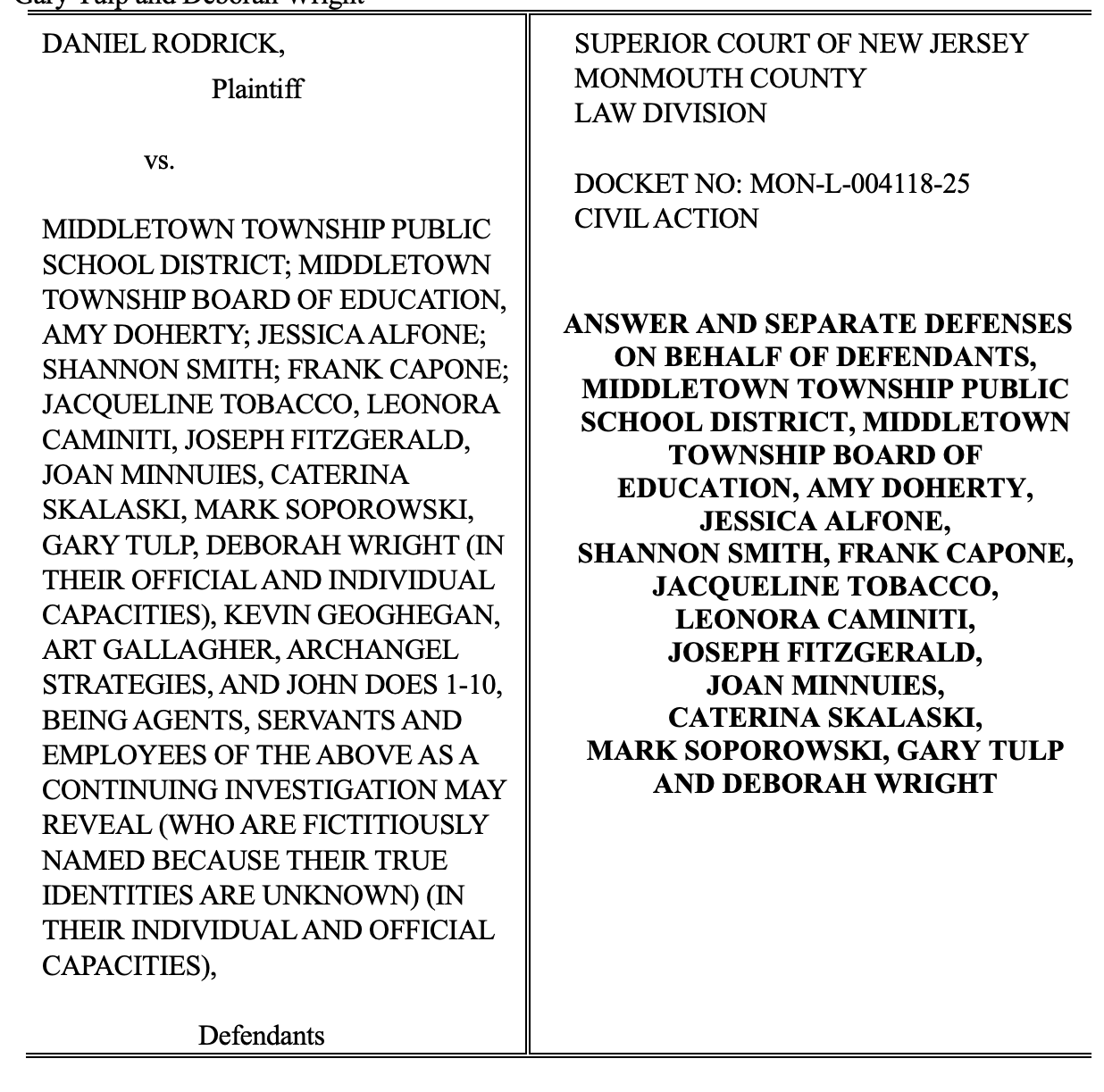
District Files Consolidated Answer in Rodrick Civil Case

School administration and board members formally respond as other named defendants have not yet appeared.

A civil lawsuit alleging retaliation, political interference, and misuse of public records within the Middletown school system has entered a new procedural phase. With a consolidated Answer now filed on behalf of the district and all school-affiliated defendants, the case moves from motions practice toward structured discovery.

The matter remains relevant beyond the named parties. It concerns the employment of a tenured educator turned town Toms River Mayor, the conduct of elected Board of Education officials, and the use of public institutions during an active political period.
Read more

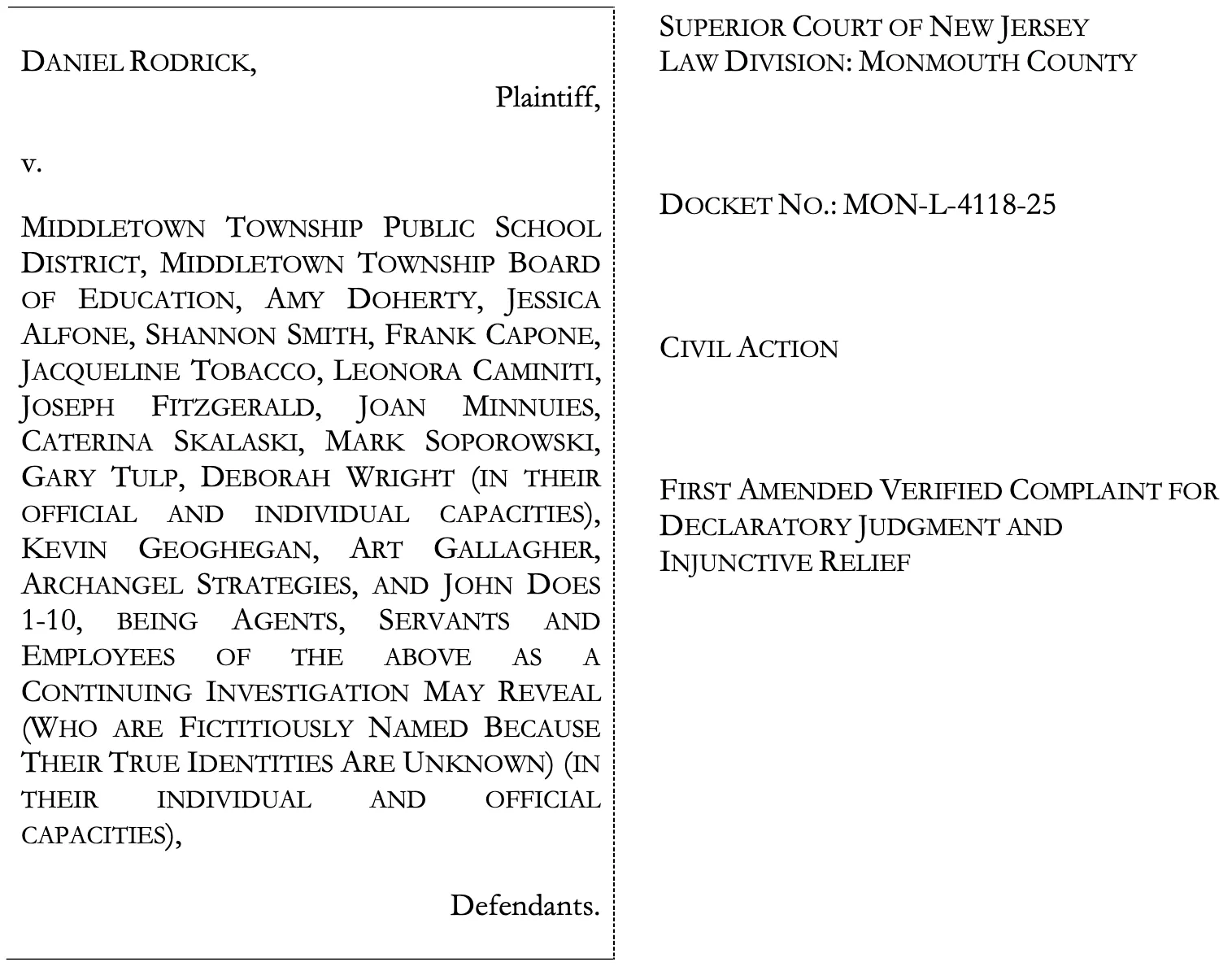
New Lawsuit Raises Questions About Partisan Influence in the Middletown BOE

A newly filed lawsuit alleges political retaliation, misuse of public records, and undisclosed coordination between campaign consultants and a local media outlet, raising questions about partisan influence inside a public school district.

A civil lawsuit filed in Monmouth County raises unresolved questions about whether partisan conflict within a school board was directed at a long-time teacher, shifting focus away from education and eroding public confidence in district governance.

The case1, brought by Daniel Rodrick against the Middletown Township Public School District and Board of Education, centers on allegations of political retaliation, misuse of public records, and the coordination of undisclosed political content published by Central Jersey Newswire. A consulting firm, Archangel Strategy Group LLC, is named as a defendant and is alleged to have played a role in preparing or facilitating content that contributed to media coverage critical of Rodrick.

At a hearing held on January 30, 2026, the court declined to grant emergency relief and also declined to dismiss the case, allowing the case to proceed through the normal litigation process.

Read more

Who Paid for the Outrage? Following the Money Behind Capone and Tobacco’s Attacks

Campaign finance records show payments to a political consulting firm linked to a local news outlet that published and amplified favorable coverage during an active school board race, raising new questions about transparency in Middletown’s political messaging ecosystem.

Local political influence doesn’t always arrive through ads or mailers. Increasingly, it moves through digital outlets that appear to be independent news sources while publishing content that aligns with campaign interests. Our review of publicly available records shows how that dynamic played out in one recent race: a media outlet linked to a campaign vendor published and amplified favorable content about a candidate during an active election period, without any public disclosure of that relationship.

In our first story, From Bumper Sticker to Ballot Box: Middletown’s Outrage Was No Accident, we examined campaign filings showing how the Monmouth County Republican Committee drew the Middletown School District into a broader, politicized debate over free speech.

Board president Frank Capone has publicly accused state lawmakers of representing “an administration in Trenton that cares far more for special interests and political agendas than putting children first [sic],” and has stated that Governor Phil Murphy “is consistently putting politics ahead of children.” At the same time, our research documents Capone’s connections to partisan political networks, suggesting a more complex relationship between his campaign activity and political influence in the school system.

A closer examination of campaign filings from Capone and Jacqueline Tobacco’s 2023 Board of Education race reveals how those manufactured dynamics appeared on residents’ newsfeeds during their campaign.

Read more

How a Local Media Network Quietly Amplified Scott Fegler’s Campaign

Federal and state campaign filings show payments to a consulting firm whose principal is linked to a local outlet that published favorable coverage during Scott Fegler’s congressional bid, raising new questions about disclosure and influence.

Local political influence doesn’t always arrive through ads or mailers. Increasingly, it moves through digital outlets that appear to be independent news sources while publishing content that aligns with campaign interests. Our review of publicly available records shows how that dynamic played out in one recent race: a media outlet linked to a campaign vendor published and amplified favorable content about a candidate during an active election period, without any public disclosure of that relationship.

A closer look at the campaign of Scott Fegler shows how these dynamics ultimately surfaced on residents’ newsfeeds.

Read more