
Middletown BOE Advances School Closures in 5–4 Vote as Superintendent Retires and State Approval Looms
After a divided 5–4 vote, Middletown’s Board of Education directed school closures for the 2026–2027 budget while accepting the superintendent’s retirement — raising unanswered questions about state approval, capital costs, and transparency.
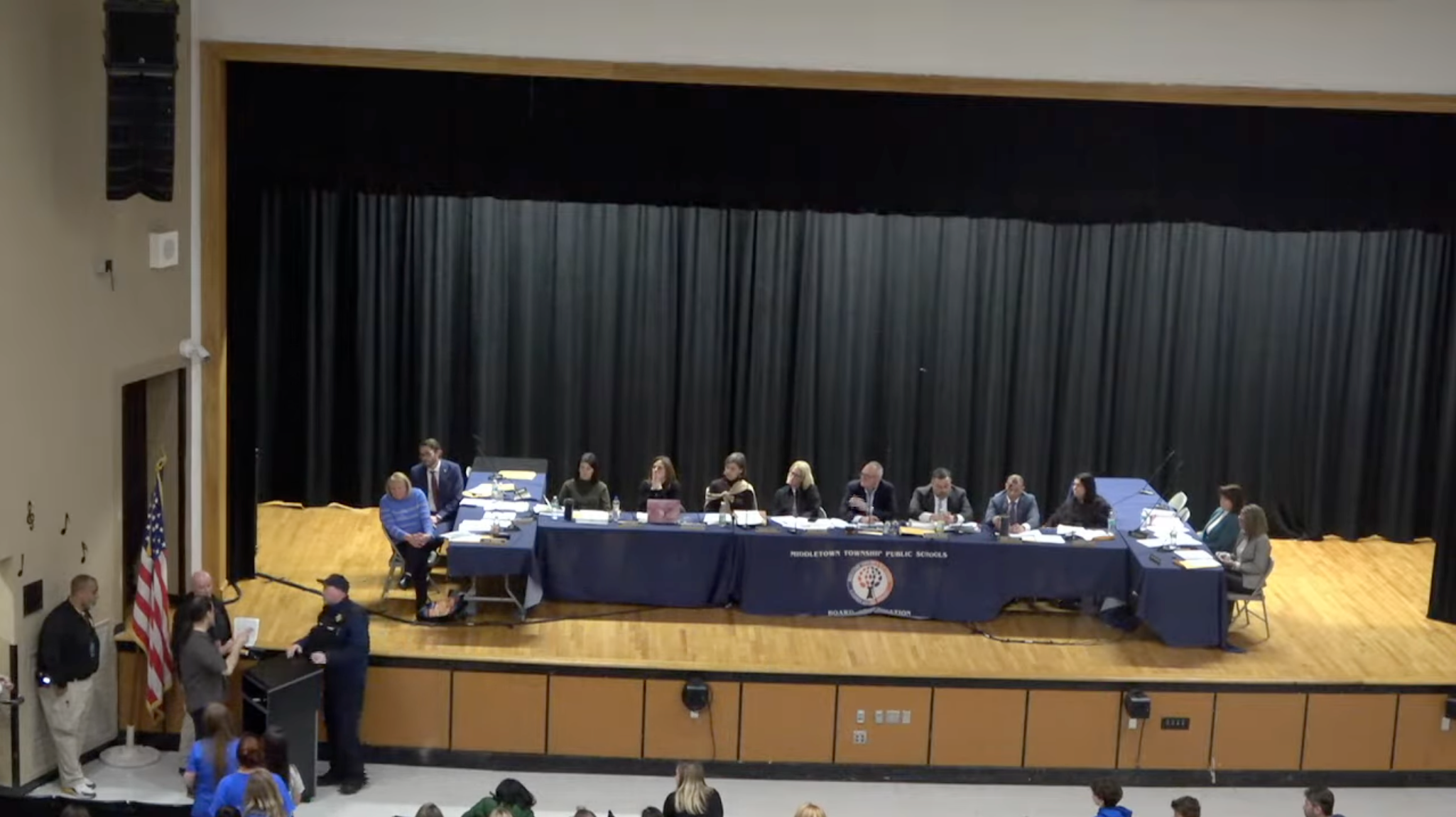
On February 26, 2026, the Middletown Township Board of Education voted 5–4 to direct administration to prepare the 2026–2027 budget including the closure of Leonardo Elementary School and Navesink Elementary School. The vote came after hours of emotional public testimony and visibly divided debate among Board members. In the same meeting, under the Personnel consent agenda, the Board formally accepted the retirement of Superintendent Jessica Alfone, effective July 1, 2026.
Taken together, those actions set the district on a course toward elementary consolidation while entering a leadership transition with no publicly outlined search process and no detailed implementation roadmap. Multiple residents referenced potential legal action during public comment. The district now moves forward with structural change amid uncertainty about oversight, continuity, and compliance.
The Vote to Advance Closures
A directive tied to the 2026–2027 budget
The published agenda did not originally include a school closure resolution.1 After a roughly 90-minute executive session, Board President Christopher Aveta opened the public portion of the meeting by introducing a motion to amend the agenda and add a new voting item:
Following discussion and consensus of the Board of Education in executive session, I am asking for a motion to amend the agenda to include Resolution 9C. Resolution 9C will provide clear direction to the administration regarding preparation of the budget. The Board must make this decision so that the administration can proceed in meeting its budget preparation obligations.
Notably, Aveta’s initial procedural introduction invoking “clear direction” did not use the words “school closure.” Moments later, Board Attorney William Burns clarified the substance of the resolution:
And just to be clear, the motion is a resolution authorizing the closing of Leonardo Elementary School and Navesink Elementary School, and directing the submission of the required assurances and approvals to the New Jersey Division of Administration and Finance and to the Executive County Superintendent of Monmouth County.
The motion to amend the agenda and add the resolution passed 5-4. The motion immediately triggered hours of debate.
Newly elected board member Erin Torres opened her remarks by questioning both the process and the information available to board members:
I’m hoping there are people up here with the experience to answer my questions, because they haven’t been answered — not to the public over the past year, and not to us here tonight. Enough is enough.
Board members Mark Soporowski, Joan Minnuies, and Deborah Wright joined Torres in expressing opposition to the closures and raising concerns about transparency and process. No board member spoke in favor of closing schools during the discussion. President Aveta and Vice President Frank Capone declined to answer several direct questions posed by both board members and members of the public.
Former Vice President and current board member Jacqueline Tobacco did not engage substantively during portions of the discussion, prompting several members of the public to remind her to “get off” her phone and remain attentive.
After extended public comment and board debate, the resolution ultimately passed by a 5-4 vote. Board members Caterina Skalaski and Sarah Weinstein joined Aveta, Capone, and Tobacco in voting in favor of the plan, despite what opponents described as substantial uncertainties surrounding its financial and operational impacts.
The action does not immediately close Leonardo and Navesink Elementary Schools. Instead, it directs the administration to prepare the 2026-2027 budget under a consolidation framework that includes their closure.
Superintendent Retirement Accepted Without Transition Plan
Leadership change during structural reorganization
Under Agenda Item 11(L), Personnel, the Board accepted the retirement of Jessica Alfone as Superintendent of Schools, effective July 1, 2026.2 There was limited discussion of succession planning, interim leadership, or a superintendent search timeline.
Several Board members and numerous public speakers referenced the superintendent transition during public comment, raising questions about continuity of leadership during a period of structural reorganization.
A superintendent search in New Jersey typically involves engagement of a search firm, public input sessions, and contract negotiations that can span several months. No public description of that process was provided during the February 26 meeting.
The district is therefore proceeding toward consolidation while facing a pending leadership vacancy at the administrative level responsible for executing the plan to close and restructure schools.
Financial Assumptions and Facility Questions
Projected savings without detailed retrofit plan
The restructuring proposal estimates recurring cost savings between approximately $3.5 and $4 million annually, with itemized savings of roughly $3,783,000. It also references projected structural deficits growing to $13.9 million by 2029–2030 absent structural change.3
However, no detailed renovation plan was presented for converting Bayshore Middle School into an elementary facility. The restructuring proposal states that Bayshore needs “very little in repair costs” and could accommodate approximately 500 elementary students.3
The document does not provide architectural studies, cost estimates for bathroom retrofits, classroom reconfiguration, age-appropriate fixtures, playground adaptation, or compliance with kindergarten classroom requirements under New Jersey administrative code. N.J.A.C. 6A:26-6.2 establishes facility standards for instructional spaces, including minimum square footage, restroom accessibility, and programmatic suitability for early childhood learners.
During the February 26 meeting, there was no separate capital cost analysis presented for retrofitting a middle school facility to house kindergarten through fifth grade students. No timeline for renovation, permitting, or inspection was discussed.
Without a publicly presented capital plan, the relationship between projected operating savings and potential renovation expenditures remains undefined in the public record.
Policy 7113.1 and State Approval Requirements
Closure requires regulatory assurances
Board Policy 7113.1 requires the Board to collect and consider information regarding enrollments, facility adequacy, revenues, safety, and alternative organizational plans before committing to school closure. It also requires citizen participation in analysis of that information and dissemination of proposed reorganization plans.4
The board will not commit itself to the closing of any school facility without first having collected and considered appropriate information regarding student enrollments, the educational adequacy of school facilities, relevant safety and traffic factors, district revenues, and alternative district organizational plans. The board will invite citizen participation in the analysis of that information and the formulation of recommendations. Information on any proposed district reorganization will be disseminated to the public, and public response will be invited by all appropriate means.
More significantly, formal closure requires approval from the Division of Administration and Finance under N.J.A.C. 6A:26-7.5. That regulation requires demonstration that sufficient building capacity exists for five years following the closing, that reassignment does not result in unlawful segregation, and that temporary facilities will not increase due to overall shortage. Written approval from the Division is required before the school’s closing.
The February 26 vote directs preparation of a budget including closure. It does not substitute for state approval. No discussion occurred during the meeting regarding the risk that the Division could decline to approve the closure request.
Under N.J.A.C. 6A:26-7.5, the Executive County Superintendent must also provide a recommendation as part of the submission.
What If the State Declines Approval
Precedent in other districts
New Jersey has previously subjected school closure proposals to state-level review and modification. In certain districts, the Executive County Superintendent or the Department of Education has required additional documentation, delayed approval pending compliance with long-range facilities planning requirements, or conditioned closure on capacity assurances.
While outright denial is uncommon when procedural requirements are met, the regulatory framework does not guarantee approval. Closure must align with the district’s approved Long-Range Facilities Plan and demonstrate compliance with facility standards and equity requirements.
The February 26 meeting did not address contingency planning in the event that the Division withholds or conditions approval. No discussion occurred regarding alternative budget adjustments if closure authorization is delayed.
Referendum Dependency and Long-Term Capital Risk
Future upgrades subject to voter approval
The restructuring proposal contemplates future building additions, HVAC improvements, and other capital upgrades to remaining facilities. It references potential referendum or bond acquisition planning and possible sale of district-owned properties to generate capital revenue.3
A referendum would require voter approval. Such processes typically occur over extended timelines and may span multiple years. If a referendum were to fail, the district would be required to reassess capital planning and financing options.
The February 26 meeting did not include discussion of interim facility conditions pending any referendum outcome. No capital timeline was presented for improvements to accommodate increased enrollment at receiving schools.
The financial model presented publicly reflects recurring operational savings but does not quantify referendum-dependent capital expenditures.
Public Comment and Process Concerns
Community raises implementation and transparency issues
Public comment stretched for several hours, despite the agenda listing a 30-minute limit. At the outset of the comment period, board member Erin Torres introduced a motion to extend public comment “until everyone gets to speak.” Vice President Frank Capone offered a competing motion to cap public comment at one hour. Following loud boos and vocal expressions of frustration from the crowd gathered in the auditorium, Capone ultimately voted against his own motion to limit the time. Amid procedural confusion regarding parliamentary rules, Jacqueline Tobacco cast the lone vote against extending public comment to allow all members of the community an opportunity to speak.
Speakers raised concerns about the superintendent transition, uncertainty surrounding potential building retrofits, enrollment projections, and the sequencing of consolidation relative to required state approvals. Broader concerns about educational quality and students’ mental health were expressed repeatedly. Those advocating for closure did not substantively respond during the public comment period.
Students from the affected schools, along with residents from across the district, delivered emotional testimony questioning how the proposed plan would improve educational outcomes town-wide.
Numerous speakers objected to the addition of the closure directive during a voting meeting rather than its introduction at a separate workshop session. Policy 7113.1, which emphasizes dissemination of information and citizen participation prior to commitment, was cited repeatedly.
With a large crowd assembled, speakers were asked to adhere to a three-minute time limit. President Aveta enforced the limit strictly, cutting off individuals who exceeded their allotted time. At one point, Aveta asked the armed police officer assigned to the meeting to remove a resident who continued speaking approximately 45 seconds past the limit.
Notably, no public comments were made in support of the closure plan.
Conclusion
Structural change without full public implementation roadmap
The February 26 vote formally ties the 2026–2027 budget to elementary consolidation at the same time the district prepares for a superintendent transition and awaits required state approval.
Projected recurring savings have been presented.3 Detailed capital retrofit costs have not. Regulatory approval from the Division of Administration and Finance remains necessary. The timing and viability of referendum-dependent facility improvements remain uncertain.
Amid this uncertain path forward, multiple residents publicly referenced potential legal intervention should the closure process proceed without what they view as full compliance with policy, transparency requirements, and state regulations.
The district now enters the March budget introduction and April public hearing cycle with consolidation embedded in its financial framework, leadership in transition, and key implementation variables — including state approval and possible litigation — unresolved in the public record.
Notes
- Middletown Township Public Schools, Board of Education Voting Meeting Agenda, February 26, 2026.
- Ibid., Agenda Item 11(L), Personnel.
- Middletown Township School District, Restructuring Proposal 2026.
- Middletown Township Board of Education, Policy 7113.1: School Closing, revised April 2024, accessed February 27, 2026, https://go.boarddocs.com/nj/middletownk12/Board.nsf/goto?open&id=DBNRLB68C488